
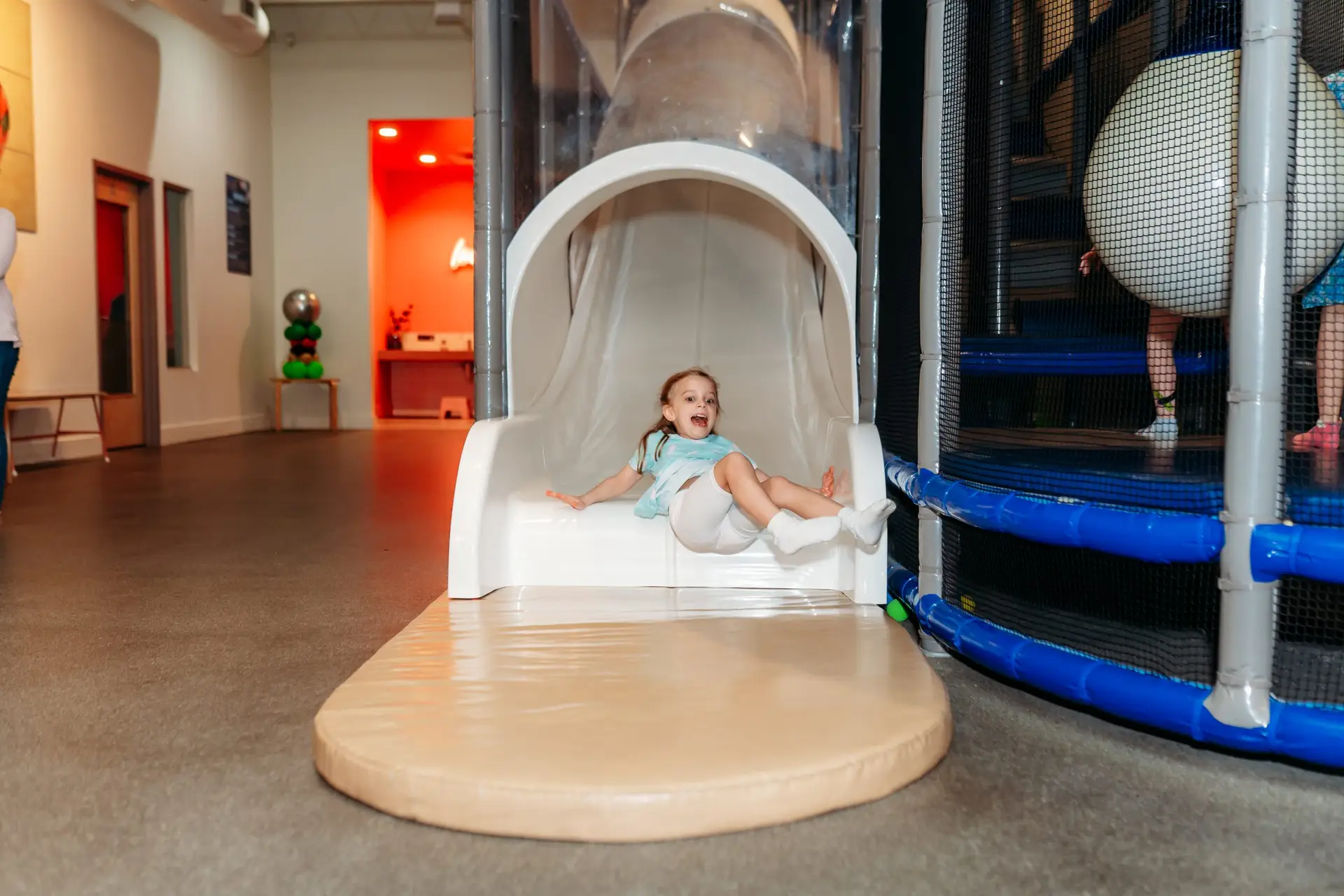
I have a video on my phone I’ve watched more times than I can count. My youngest, 23 months old, sitting at the top of the big slide at Ready Set FUN. His older brother has already gone down twice, coaching him from the bottom. Come on. You can do it. Finally, big brother goes back up, gets behind him, and gives him a little push.
He makes it down. He’s not sure whether to laugh or cry. He does a little of both.
Two weeks later, same slide. This time he’s racing his best friend to the top, his brother right behind them. No hesitation. No help needed. Just pure, delighted chaos.
Six months after that, at two and a half, he goes down by himself. Confidently. Happily. Like he owns the place.
I didn’t plan any of this as a development exercise. I just brought my kids to play. But what I watched happen over those six months is exactly what child development researchers have been documenting for decades. Physical confidence doesn’t come from being taught. It comes from being given a place to try, fail, try again, and eventually fly.
Here’s what the research actually says, and why it matters for how you think about where your child spends time this summer.
What Are Gross Motor Skills, Exactly?
Gross motor skills are the large-muscle movements that allow your child to move through the world. Walking, running, jumping, climbing, balancing. They’re the foundation everything else is built on. Fine motor skills (writing, drawing, manipulating small objects) don’t develop well without a solid gross motor base first.
The specific skills that fall under the gross motor umbrella include:
- Balance and stability
- Core strength
- Coordination
- Spatial awareness
- Proprioception
- Agility
Proprioception is worth pausing on because it’s the one parents hear least about. It’s the body’s ability to sense its own position in space. It’s what tells your child where their feet are without looking down, and how much force to use when they land. It develops directly through the kinds of active physical play that playgrounds are built for.
How Much Physical Activity Do Toddlers Actually Need?
Sources: World Health Organization physical activity guidelines for children under 5; National Association for Sport and Physical Education (NASPE) via Alta Pediatric Therapy
Most kids aren’t hitting these numbers on a typical day at home. Screen time, limited space, and the general logistics of managing small children indoors mean that the gap between recommended and actual physical activity is real and common.
Why the Playground Is One of the Best Tools You Have
A 2023 scoping review published in the National Institutes of Health database analyzed 14 studies on playground use and children’s fundamental movement skills. The conclusion was direct:
Unstructured play at playgrounds is important for children’s physical development, challenging their movement abilities such as balance, agility, coordination, and spatial awareness.
PMC / National Institutes of Health, 2023The same review found that well-designed playgrounds with varied features targeting balance, climbing, and movement provide opportunities for children to enhance each category of fundamental movement skills simultaneously. Not one at a time. All at once, through a single trip down the slide.
Child Trends, a nonpartisan research organization focused on child wellbeing, reinforces this: play areas that allow a variety of active behaviors such as running, jumping, and climbing tend to promote vigorous physical activity, which has been linked to accelerated motor skill development.
What a Slide Actually Teaches
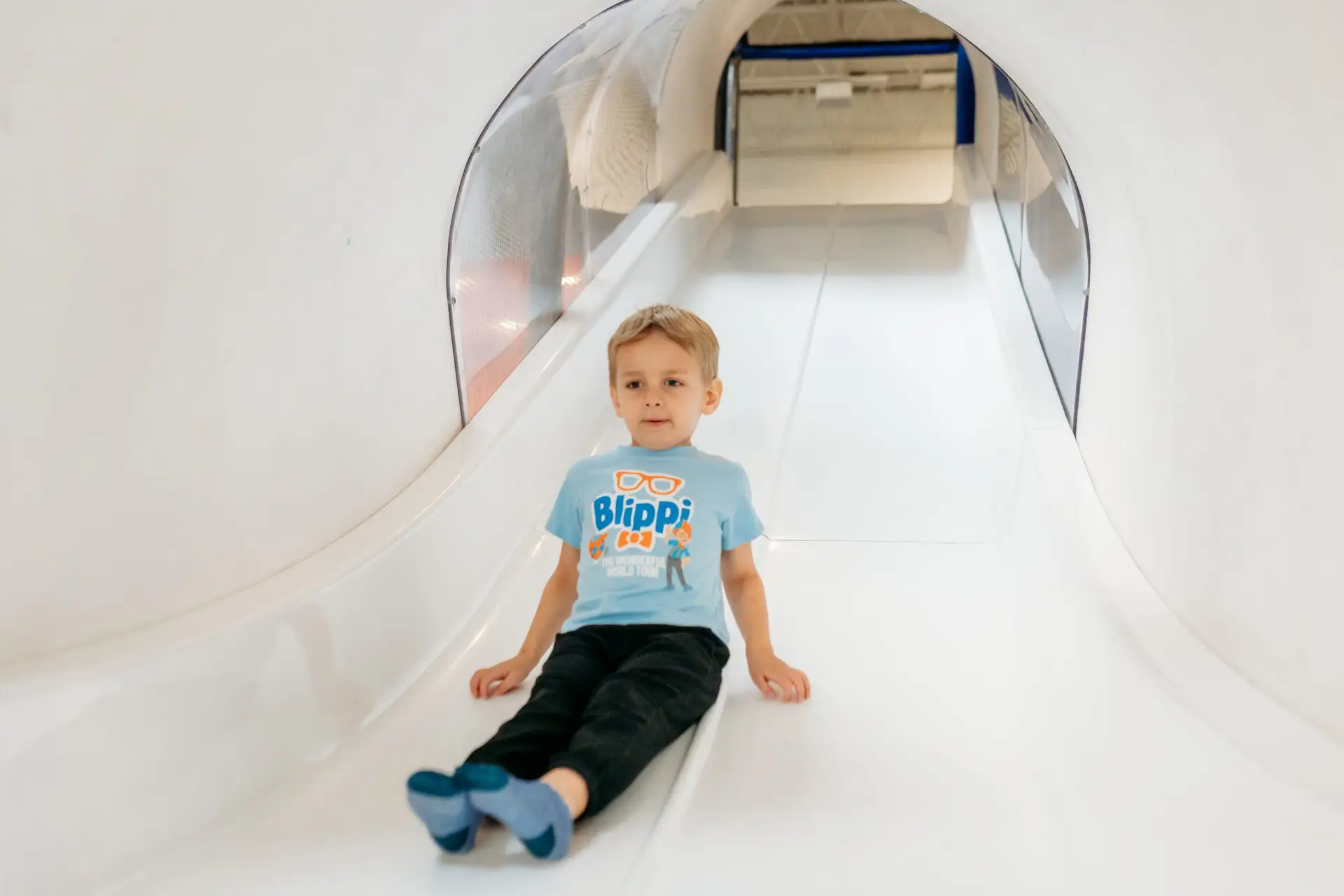
The big slide at Ready Set FUN, Sandy Springs. Every ride is a full gross motor workout.
Let’s be specific, because “play is good for kids” is not useful advice. Here is what physically happens when a toddler takes on a big slide:
Climbing up
The ladder requires eyes, hands, feet, and legs to work together in sequence. That’s coordination being built in real time. It also demands upper and lower body strength and the spatial judgment to figure out where each limb goes next.
Waiting at the top
Balance, spatial orientation, and the emotional regulation required to pause at the edge of something scary. That pause is doing real developmental work.
The ride down
The vestibular system, the part of the inner ear responsible for equilibrium, is directly stimulated by the sensation of the slide. Better vestibular input means better balance. It’s also a proprioceptive challenge: the child has to judge speed, position, and landing without seeing the ground approach.
Landing and walking away
Spatial awareness in action. The child learns, through repetition, how to position their body for landing. Research from AAA State of Play notes this skill transfers directly to everyday movement: walking on uneven surfaces, navigating stairs, and moving through space with confidence.
Successfully climbing up the slide, riding down the chute, and walking away unscathed is a great confidence booster. It’s also a full gross motor workout they didn’t know they were doing.
AAA State of Play, Child Development ResearchRepetition Is the Mechanism. Intrinsic Motivation Is the Engine.
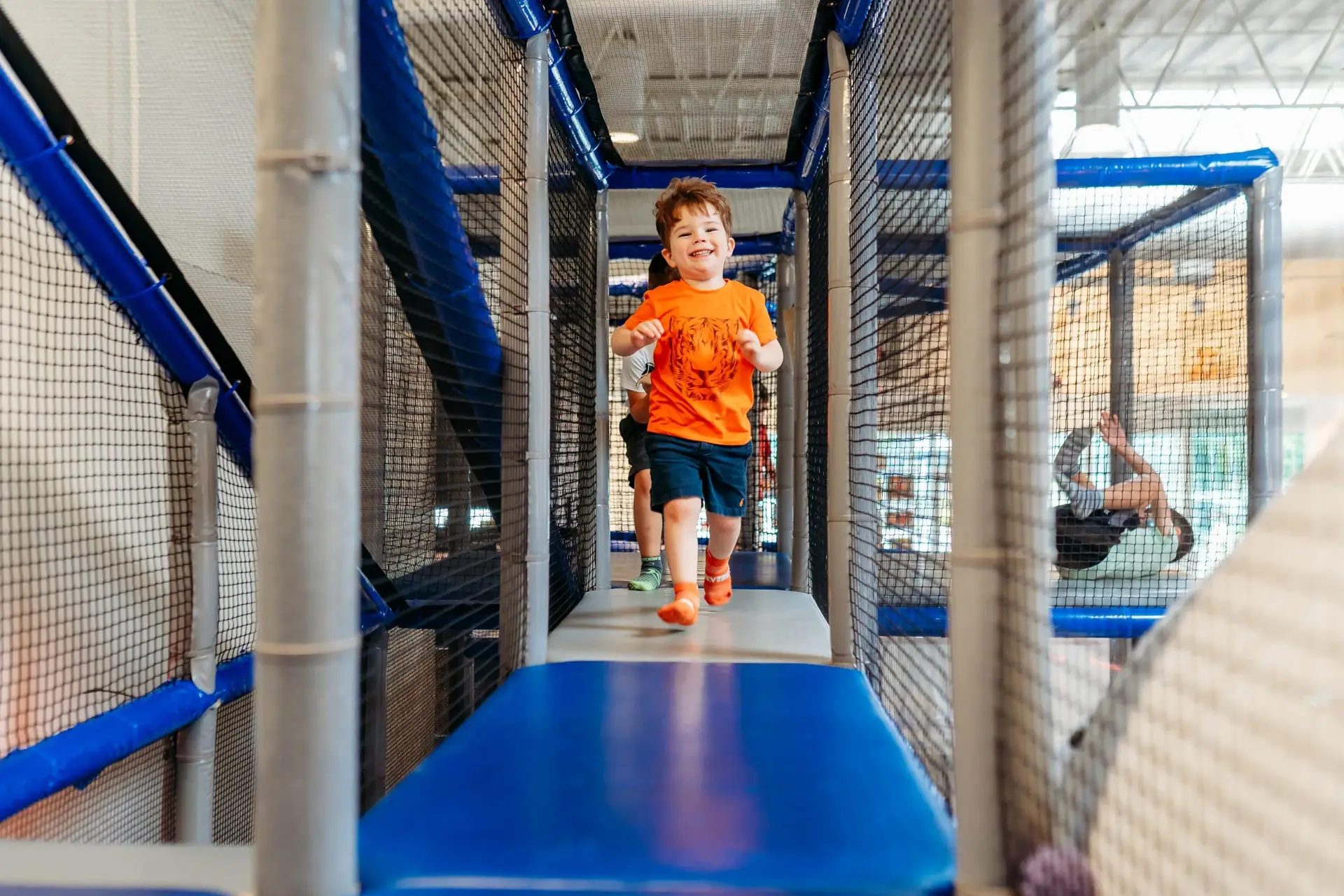
When kids choose the activity, they do it 40 times. That repetition is where development actually happens.
This is the piece that gets missed most often in conversations about child development. Gross motor skills don’t develop from a single exposure. They develop through repetition, and lots of it.
The reason unstructured play is so effective isn’t just that it’s physically active. It’s that children will repeat an activity they’ve chosen far more often than one they’ve been assigned. A child who loves the slide will go down it 40 times in an afternoon. A child doing a structured physical exercise drill will do it six times before losing interest.
That gap in repetition is everything. Forty reps versus six reps, every session, compounded over weeks and months. The development isn’t magic. It’s volume, driven by the fact that the child actually wants to be there.
What This Means for This Summer
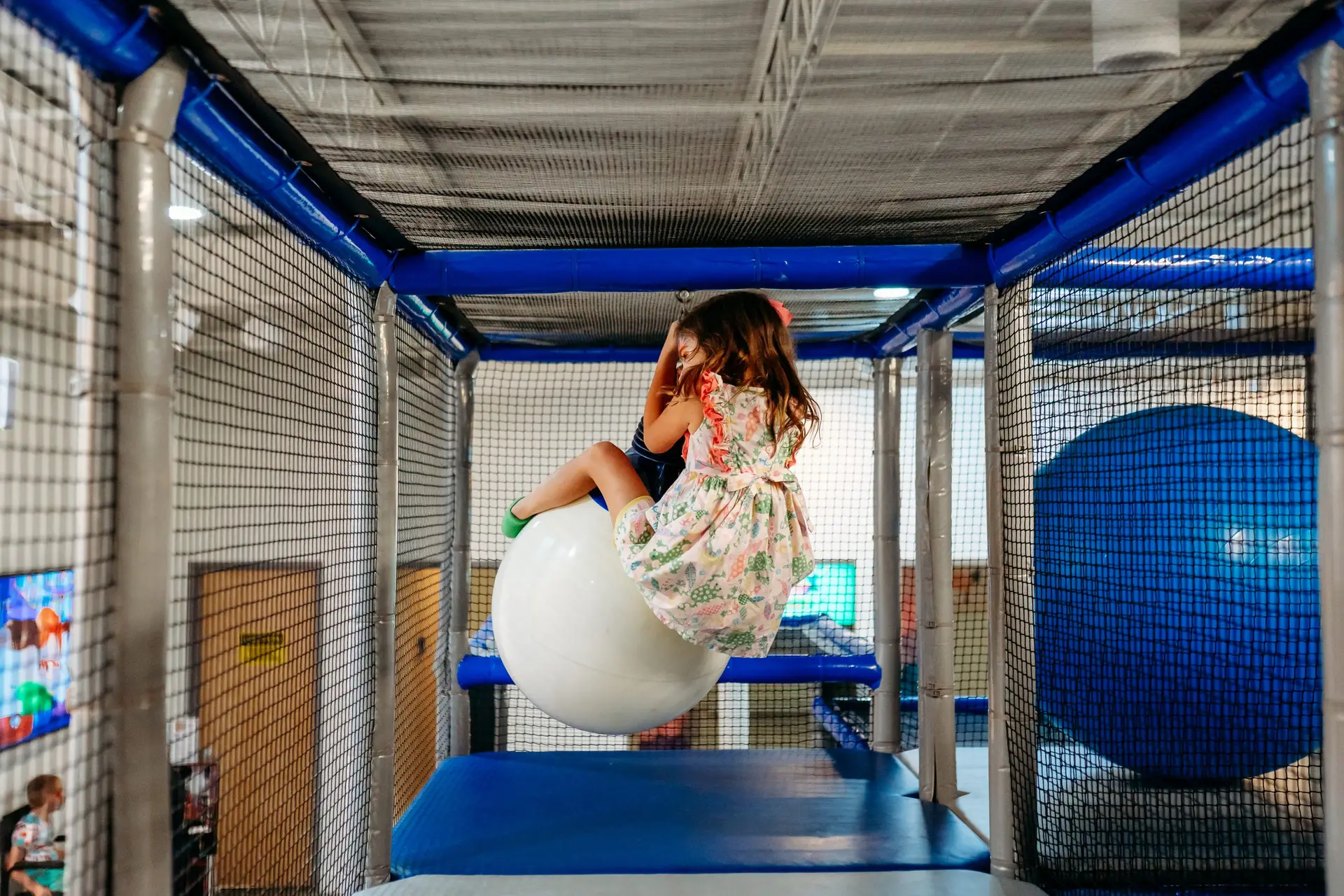
Balance, core strength, and coordination. All happening on the big ball at Ready Set FUN.
Atlanta summers are hot. Backyards become non-negotiable by 10am. The answer isn’t less physical activity, it’s moving it indoors where the temperature is controlled and the equipment is built for exactly this kind of development.
RSF’s big play structure gives toddlers the kind of varied physical challenge that research consistently identifies as most effective for gross motor development. Slides, crawl tunnels, climbing features, bridges, and the big ball are not just entertainment. Each one targets a different set of skills, and kids move between them on their own terms, which means they’re getting more reps of more movement patterns than any structured class could design.
My youngest went from needing a push to flying down solo in six months. Not because I ran a development program or signed him up for a class. Because he came back, tried again, and the playground did the rest. That’s the whole thing.
This summer, build skills with confidence.
RSF memberships start at $65 for unlimited playtime all summer long. Rain, shine, heat wave, whatever Atlanta throws at you.
Get Your Summer MembershipUnlimited playtime. All summer. One price.
Sources
- World Health Organization. Guidelines on Physical Activity, Sedentary Behaviour and Sleep for Children Under 5 Years of Age. WHO, 2019.
- National Association for Sport and Physical Education (NASPE). Active Start: A Statement of Physical Activity Guidelines for Children From Birth to Age 5. Via Alta Pediatric Therapy.
- Meijer M, et al. The role of playgrounds in the development of children’s fundamental movement skills: A scoping review. PMC / National Institutes of Health, 2023. pmc.ncbi.nlm.nih.gov
- Child Trends. Playgrounds Represent Opportunities for Children’s Physical Development. childtrends.org
- Cleveland Clinic. Gross Motor Skills: What They Are, Development and Examples. December 2025. clevelandclinic.org
- AAA State of Play. 7 Benefits of Playing on the Slide for Child Development. blog.aaastateofplay.com
- Lovevery. 8 Playground Activities That Build Your Toddler’s Balance and Coordination. July 2024. blog.lovevery.com